Posted: July 27, 2026
The global network of scientists within the IEA SHC Task 69 on Solar Hot Water for 2030 has been examining thermosiphon markets worldwide from July 2022 to March 2026. They analysed technical characteristics, innovations and typical sources of error and how to avoid them. The network has now published the results of this work in a number of reports which are available for download here (https://task69.iea-shc.org/publications). In this news article, we present findings on market potential and discuss the practical solutions listed to address critical issues such as overheating, leakage, freezing or thermal shock. The drafting of both reports was supervised by Li Bojia, Professor at the Solar Energy Application Center of the China Academy of Building Research in China.
Potential for thermosyphon systems worldwide
The report Thermosyphon System Potential (https://task69.iea-shc.org/Data/Sites/1/publications/IEA-SHC-Task69-B.1-Report%20-of-thermosyphon-system-potential-Final.pdf) sees substantial but regionally differentiated market potential for thermosyphon systems, especially in mild and sunny climates, off-grid or weak-grid areas, and where simple, low-cost technology is favored over complex pumped system.
Thermosiphon systems, being simple, passive and pump-free, are highlighted as particularly suitable for Asia, Africa and Latin America, where they already dominate domestic hot water solar markets and can further expand due to low upfront and lifetime costs and resilience to grid failures. At the same time, the report notes that thermosiphon markets are under pressure from heat pumps and electrification policies, so future potential depends on improving competitiveness and user experience.
Thermosiphon systems are widely used in sunny, mild-climate regions, mainly for domestic hot water in residential and tourism buildings. In Southern Europe (Cyprus, Greece, Turkey), many local manufacturers supply flat-plate, usually indirect systems with insulated, enameled tanks.
In Asia, India relies mainly on low-cost direct evacuated-tube units for single houses and urban apartments. These systems are also widespread in rural areas in China, whereas indirect systems – with both flat-plate or evacuated tube collectors are used in Chinese multi-storey urban buildings under national solar and building standards.
In Latin America, direct flat-plate thermosiphons dominate warm urban zones in Brazil, Mexico and the Caribbean, whereas evacuated-tube units are adopted in colder southern regions to improve winter performance. In North America, a notable thermosyphon market exists mainly in Puerto Rico, where assemblers such as Universal Solar, Tanagua, Sun is Life and MC Green Solutions provide direct flat-plate packages that benefit from high electricity prices and financial incentives.
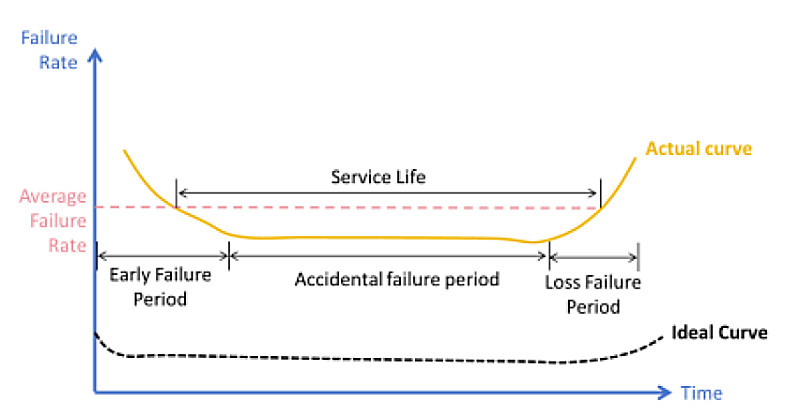 Typical product failure rate curve
Graphic: Task 69
Practical solutions to address and avoid critical issues
Another report worth reading is entitled Durability and Reliability Improvement Pathways for Thermosyphon Solar Collectors (https://task69.iea-shc.org/Data/Sites/1/publications/IEA-SHC-Task69-B.3-Report-on-durability-and-reliability-improving-research-and-technical-results-Final.pdf). It systematically lists and integrates relevant research findings to advance the overall performance, lifespan and reliability of solar water heating systems. Together, the pathways listed below move thermosyphon systems from simple passive devices toward intelligent, low-maintenance components of robust building energy infrastructures.
- Ageing under environmental exposure: Exposure tests conducted in China revealed that the rubber sealing hardened over time, leading to the formation of gaps at the joints between the tubes and the manifold. These gaps increased heat losses. Future work should therefore focus on selecting more durable sealing and insulation materials to minimize thermal performance degradation.
- Overheating control: Current strategies for mitigating overheating in siphon-type solar water heaters fall into three main categories: (1) dissipating excess heat using heat dissipation and pressure relief devices; (2) limiting solar heat gain through smart collector tube shading or automatic sunshade systems; and (3) reducing overheating by optimizing system circulation and using high-temperature, low-efficiency absorber coatings. Together, these approaches balance thermal efficiency with overheating protection, improving both system safety and durability.
- Mitigating heat loss: The thermal storage tank has a significant impact on the performance of solar thermosyphon water heating systems by losing heat over night. Researchers found that the thermosyphon tank design had a significant effect on the system’s performance. The durability of hot water availability increased by more than 40% since the phase change material in the storage tank reduces heat losses to the surroundings. This design solves the core problem of heat loss at night in solar hot water systems through innovative PCM and water tank structures. According to the authors it is both technically feasible and economically viable.
- Freeze protection: The authors of the report list three possible freeze-protection strategies: (1) integration of smart drain-back control; (2) improved antifreeze heat-transfer media, and (3) optimized piping with advanced insulation and self-regulating electric heating cables to keep systems operating reliably across very cold climates.
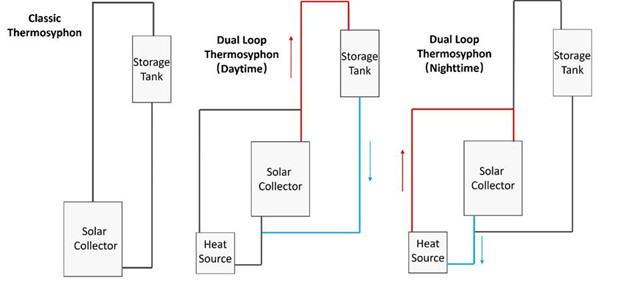
The graphic compares the dual-loop thermosyphon system on the right with a classic, glycol-filled thermosyphon system on the left. The dual-loop system is filled with pure water and offers an entirely passive freeze-protection logic via an additional heat source for example geothermal water.
Graphic: Task 69/Li Haimeng
Passive freeze protection through dual-loop thermosyphon design
Another fundamental innovation is described at dual loop thermosiphon system in the report. These systems are usually introduced to overcome the freezing and corrosion problems associated with classic conventional solar water heating systems. Chinese researchers have compared the performance of both system types. Measurements indicate that the monthly photothermal efficiency of the dual loop-thermosyphon system is slightly higher than that of the classic system.
The core innovation of the dual-loop thermosyphon system lies in its ability to eliminate mechanical pumps and sensors by using simple T-fittings to create a secondary, entirely passive freeze-protection circulation loop beneath the solar collector. During the day, solar radiation heats the water within the collector, reducing its density and driving natural circulation as the warmer water rises into the storage tank. During cold nights, the water inside the collector cools, increasing its density and causing the colder, heavier water to descend into the lower loop. It is then replaced by relatively warmer geothermal water (typically above 4°C), providing passive freeze protection through natural convection.
This operating principle differs fundamentally from that of conventional indirect thermosyphon systems, which rely on a closed loop containing an antifreeze fluid to transfer heat indirectly to domestic water through a heat exchanger located inside the storage tank. By eliminating the need for antifreeze fluids and heat exchanger components, dual-loop thermosyphon systems reduce both system complexity and cost.Taken together, the IEA SHC Task 69 reports show that thermosyphon solar water heaters can play a much larger role in global decarbonisation if their proven simplicity is combined with modern reliability and control concepts. The durability work of the task team offers concrete pathways to tackle ageing, overheating, heat loss and freezing through better materials and smarter hydraulics. If manufacturers and policymakers build on these finding thermosyphon systems can evolve from low-cost niche products into robust, low-maintenance smart hot water solutions embedded in future building energy systems.
Websites of organizations mentioned in this news article: